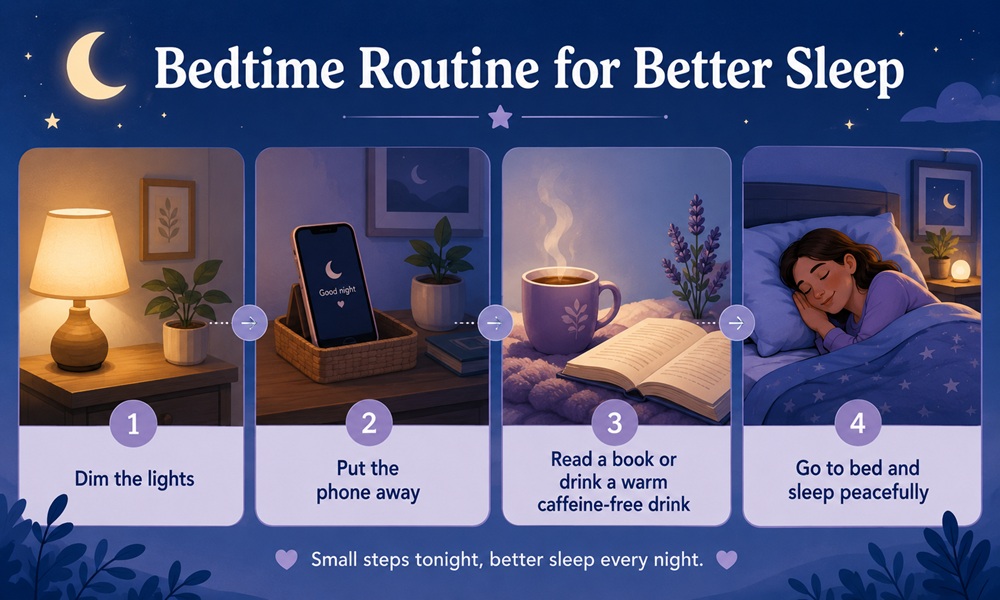
Good sleep rarely begins the moment your head hits the pillow. It begins about an hour earlier. A predictable wind-down routine tells your brain that night has arrived and lets your nervous system shift out of “go” mode and into rest. Sleep researchers call the collection of these habits “sleep hygiene,” and it is one of the most reliable, drug-free ways to fall asleep faster and wake up more refreshed.
Quick answer: Spend the last 60 minutes before bed dimming lights, cooling the room to about 18–20°C (65–68°F), powering down screens, and doing one calming activity. Keep a fixed wake time every day — even on weekends.
The 60-minute countdown
| Time before bed | What to do |
| 60 min | Power down work and screens. Dim the lights. Set the room cool. |
| 45 min | Do a light tidy or prep for tomorrow so your mind can let go. |
| 30 min | Take a warm shower or bath; the drop in body temperature afterward signals sleep. |
| 20 min | Switch to a calming activity: read on paper, gentle stretch, slow breathing. |
| 10 min | Do a “worry dump” — write tomorrow’s to-dos on a notepad by the bed. |
| 0 min | Lights out at a consistent time in a dark, quiet room. |
The four environment rules
Your bedroom is either helping you sleep or quietly fighting you. Four simple settings cover most of it.
- Around 18–20°C (65–68°F) suits most people. A slightly cool room helps your core temperature fall, which is part of how the body initiates sleep.
- Use blackout curtains or a sleep mask. Even small amounts of light suppress melatonin, the hormone that signals it is time to sleep.
- Mask intrusive noise with a fan or white-noise machine. Heavy curtains and rugs also absorb sound.
- Screen-free. Power devices down 30–60 minutes before bed. Both the blue light and the stimulating content delay sleep, and the effect builds night after night.
The piece most sleep advice misses
You cannot sleep well if your nervous system is still in fight-or-flight. All the blackout curtains and cool air in the world will not override a wired body. This is the subtle shift many experts are now emphasizing: less obsessive sleep tracking and gadget-chasing, and more genuine nervous-system regulation. The aim is to arrive at bedtime already calm, not to “try harder” to fall asleep.
Two simple tools help you downshift:
- Non-sleep deep rest (NSDR). A 10–20 minute body scan or yoga nidra, even earlier in the afternoon, lowers evening nervous-system activation and teaches your body how to shift gears.
- Slow breathing. A longer exhale than inhale signals safety to the body, slows the heart rate and eases you toward sleep. Even a few minutes works.
Daytime habits that protect your night
What you do at 8 a.m. and 2 p.m. affects how you sleep at 11 p.m. These daytime choices reinforce a healthy rhythm.
- Get morning daylight soon after waking to anchor your body clock.
- Finish caffeine by early afternoon; it can linger 8–10 hours in your system.
- Keep naps short (under 30 minutes) and not too late in the day.
- Avoid heavy meals and alcohol close to bedtime — alcohol may help you nod off but fragments sleep later in the night.
- Exercise regularly, but experiment with timing; for some, a workout within two hours of bed is too stimulating.
- Keep a steady wake time; it reinforces your rhythm even more than a fixed bedtime does.
Sleep hygiene will not cure every sleep problem on its own, but for most people it is the highest-leverage place to start. Give a new routine a couple of weeks before judging it.
Frequently Asked Questions
What is the ideal bedroom temperature for sleep?
Most people sleep best around 18–20°C (65–68°F). The cool room supports the natural drop in body temperature that helps you fall and stay asleep.
How long before bed should I stop using screens?
Aim for 30–60 minutes. Even modest reductions in evening screen time add up to noticeably better sleep across the week.
Why do I wake up at 2 or 3 a.m.?
Common culprits include alcohol, late heavy meals, a too-warm room, and stress that keeps the nervous system activated. A worry-dump notepad and a cooler room often help.
Does a warm shower really help you sleep?
Yes. The shower warms you, and the rebound cooling of your body afterward mimics the temperature drop that naturally precedes sleep, helping you drift off faster.
General information only. Ongoing insomnia or a suspected sleep disorder should be assessed by a healthcare professional.